Engineering Courses After 12th Science (PCM): Complete Career Guide for Students in 2026
Quick Answer: The best engineering courses after 12th Science (PCM) in 2026 include Computer Science Engineering (CSE), Artificial Intelligence (AI) & Data Science, Cyber Security, Mechanical Engineering, and Civil Engineering. CSE and AI offer the highest starting salaries (₹5L - ₹15L+), while core branches provide immense opportunities in automation, smart infrastructure, and the EV sector.
Key Takeaways
- Tech is Dominating: AI, Machine Learning, and Cyber Security are the fastest-growing specializations.
- Core is Evolving: Mechanical and Electrical engineering are seeing a massive revival due to the Electric Vehicle (EV) and Robotics boom.
- Skills Over Degrees: Practical coding, problem-solving, and software proficiency matter more than just your B.Tech certificate.
- Interdisciplinary Approaches: Mechatronics (Mechanical + Electronics) is highly sought after in modern manufacturing.
Table of Contents
- The Engineering Landscape in 2026
- 1. Computer Science Engineering (CSE)
- 2. Artificial Intelligence & Data Science
- 3. Civil Engineering
- 4. Mechanical Engineering
- 5. Electrical & Electronics Engineering
- How to Choose the Right Branch
- Myth vs. Fact: Engineering Branches
- Frequently Asked Questions (FAQs)
- Conclusion & Next Steps
The Engineering Landscape in 2026
Congratulations on completing your 12th boards in the Science stream with Physics, Chemistry, and Mathematics (PCM)! You are now at a critical crossroads. Engineering remains one of the most respected, secure, and lucrative career paths globally. However, the definition of an "Engineer" has drastically evolved.
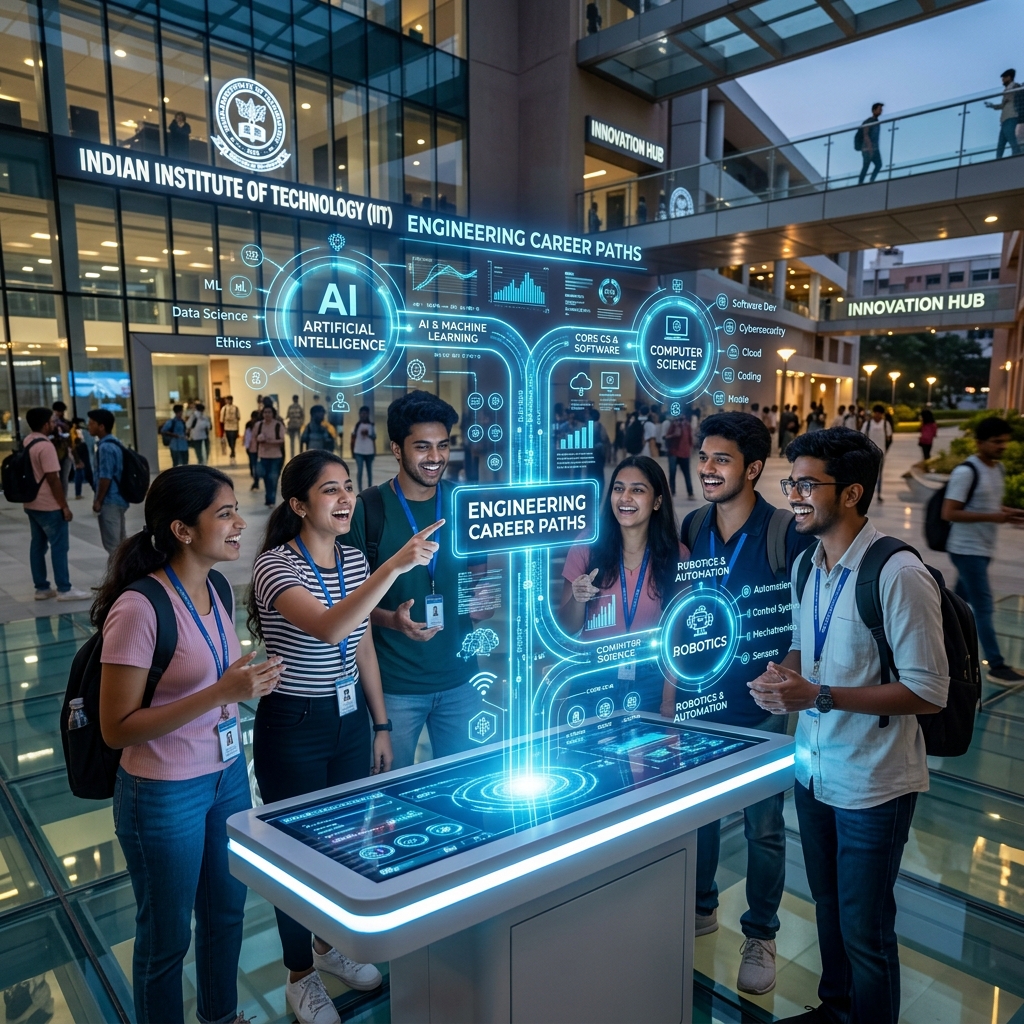
We are in the era of Industry 4.0. It's no longer just about building bridges or writing basic software. Today, engineering is about developing smart cities, training autonomous AI models, securing national cyber infrastructure, and designing sustainable energy grids. Let's break down the top engineering courses you should consider in 2026.
1. Computer Science Engineering (CSE)
CSE remains the undisputed king of engineering branches. If you love logic, problem-solving, and technology, this is the field for you.
What You Will Learn
You will dive deep into programming languages (Java, Python, C++), algorithms, database management systems, cloud computing, and full-stack web development.
Future Scope & Jobs
The demand for software engineers is insatiable. Graduates can work as Software Developers, Systems Analysts, Cloud Architects, and DevOps Engineers. Companies like Google, Amazon, TCS, and Infosys are mass recruiters.
2. Artificial Intelligence (AI) & Data Science
While often offered as a specialization within CSE, AI has grown so massive that it is now a dedicated B.Tech degree in top colleges like JEC Kukas.
What You Will Learn
You will study neural networks, machine learning, natural language processing (NLP), big data analytics, and robotics.
Future Scope & Jobs
AI engineers are currently the highest-paid professionals in the tech industry. Roles include AI Architect, Data Scientist, and Machine Learning Engineer. As AI integrates into healthcare, finance, and automotive industries, the job security is unmatched.
3. Civil Engineering
Civil engineering is one of the oldest and most fundamental branches, but it is undergoing a massive high-tech transformation.
What You Will Learn
Beyond traditional structural analysis, concrete technology, and surveying, modern civil engineering includes 3D modeling (AutoCAD, Revit), smart city planning, green building technologies, and disaster management.
Future Scope & Jobs
With India's massive infrastructure push (highways, bullet trains, smart cities), civil engineers are in high demand in both government sectors (PSUs, PWD) and private conglomerates like L&T and Tata Projects.
4. Mechanical Engineering
Often called the "mother of all engineering branches," mechanical engineering is for those who love machines, physics, and design.
What You Will Learn
Thermodynamics, fluid mechanics, kinematics, and CAD/CAM design. More importantly, the 2026 curriculum focuses heavily on Robotics, Automation, and Mechatronics.
Future Scope & Jobs
Mechanical engineers are critical to the aerospace, automotive, and manufacturing industries. The rise of automation means mechanical engineers who can code (Mechatronics) are highly sought after.
5. Electrical & Electronics Engineering (EEE)
If there is one industry booming faster than software, it is the Electric Vehicle (EV) and renewable energy sector.
What You Will Learn
Circuit design, power systems, control systems, microprocessors, and battery technology.
Future Scope & Jobs
EEE graduates are essential for designing the next generation of EVs, solar power grids, and smart home devices. Core companies like Siemens, Bosch, and Tesla-aligned startups are desperate for electrical engineers.
How to Choose the Right Branch (Checklist)
Don't just follow the crowd. Use this checklist to make an informed decision:
- Assess Your Interest: Do you like coding? Go for CSE/AI. Do you like physics and tangible machines? Go for Mechanical/Civil.
- Check the Curriculum: Look at the syllabus of top colleges like JEC Kukas to see if the subjects excite you.
- Look at Placement Trends: Research which branches have the highest hiring rates and average salaries in your state.
- Future Proofing: Avoid highly niche branches for undergraduate degrees. Stick to broad branches (like CSE or Mechanical) and specialize later.
Still Confused About Your Career?
Our expert career counselors at JEC Kukas can help you choose the perfect engineering branch based on your aptitude and goals.
Myth vs. Fact: Engineering Branches
The MythThe FactCivil and Mechanical are "dead" branches.Completely false. Infrastructure and manufacturing are the backbone of the economy. Smart cities and EVs have created a massive surge in core engineering jobs.You have to be a math genius for CSE.While logic is important, modern software development relies more on problem-solving, creativity, and understanding frameworks than complex calculus.AI will replace Software Engineers.AI is a tool. It will replace repetitive coding, but it will massively increase the demand for engineers who can build, manage, and audit AI systems.
Frequently Asked Questions (FAQs)
1. Which engineering branch has the highest salary?
Currently, Artificial Intelligence (AI) and Computer Science Engineering (CSE) offer the highest starting salaries, often ranging from ₹5 LPA to over ₹20 LPA depending on the candidate's skills.
2. Is Civil Engineering a good option in 2026?
Yes. With rapid urbanization and government infrastructure projects, Civil Engineering offers highly stable jobs in both the public (government) and private sectors.
3. What is the scope of Mechanical Engineering?
Mechanical engineering is evolving. The scope is massive if you focus on modern fields like Robotics, Automation, 3D Printing, and Electric Vehicle design.
4. Can I take Computer Science if I am weak in Math?
Basic math and logic are required, but you don't need to be a math prodigy. Focus on developing strong programming and problem-solving skills.
5. What is the difference between CSE and IT?
CSE focuses more on the underlying architecture of hardware and software (algorithms, compilers), while Information Technology (IT) focuses on applying software solutions to business problems.
6. Which branch is best for government jobs?
Civil, Mechanical, and Electrical Engineering have the highest number of vacancies in government sectors like PSU, Railways, and PWD.
7. Does JEC Kukas offer specialized AI courses?
Yes, JEC Kukas offers dedicated B.Tech programs in Artificial Intelligence and modern computing technologies.
8. What are the emerging engineering fields?
Emerging fields include Cyber Security, Data Science, Mechatronics, Bio-Medical Engineering, and Renewable Energy.
9. Can I change my branch after the 1st year?
Yes, most RTU-affiliated colleges allow branch changes after the first year, strictly based on academic merit and seat availability.
10. Do I need to learn coding if I choose Mechanical Engineering?
It is highly recommended. Modern mechanical engineering relies heavily on software for design (CAD), simulation, and automation (Mechatronics).
11. What is Mechatronics?
Mechatronics is a multidisciplinary branch that combines mechanical, electrical, and computer engineering to design automated systems and robots.
12. Which branch is best for girls?
All branches are equally suitable. However, CSE, AI, and Electronics often offer more flexible work environments and remote working opportunities.
13. What is the role of an Electronics & Communication Engineer (ECE)?
ECE engineers design and maintain telecommunication systems, IoT devices, microprocessors, and networking infrastructure.
14. How do I decide between CSE and AI?
If you want a broad foundation in all aspects of software, choose CSE. If you are specifically passionate about machine learning, data, and predictive models, choose AI.
15. Are there good placements for Civil Engineering?
Yes, top real estate firms, construction conglomerates (like L&T), and architecture firms actively recruit civil engineers from good colleges.
16. What is the duration of a B.Tech course?
A standard B.Tech program is 4 years long, divided into 8 semesters.
17. Does branch choice affect MBA admissions later?
No. Any recognized B.Tech degree makes you eligible for an MBA. In fact, engineers with diverse backgrounds often do well in management.
18. What skills are recruiters looking for?
Beyond technical knowledge, recruiters look for communication skills, leadership, adaptability, and hands-on project experience.
19. What is Cyber Security Engineering?
It focuses on protecting computer systems, networks, and data from digital attacks and unauthorized access.
20. Are core branches harder than software branches?
Difficulty is subjective. Core branches require strong visualization and physics concepts, while software requires strong logic and continuous learning of new languages.
Conclusion & Next Steps
Selecting your engineering branch is a major life decision, but there is no "wrong" choice if you follow your passion. Whether you want to code the next viral app, design sustainable skyscrapers, or build electric cars, a B.Tech degree provides the foundation.
Jaipur Engineering College (JEC Kukas) offers all these premier branches with state-of-the-art infrastructure and a stellar placement record. Evaluate your interests, consult with mentors, and take the leap into a rewarding career.
Contact JEC Kukas Today to learn more about our B.Tech programs and secure your admission for 2026!
Author: JEC Kukas Admission Cell | Last Updated: July 17, 2026 | Reading Time: 11 Minutes